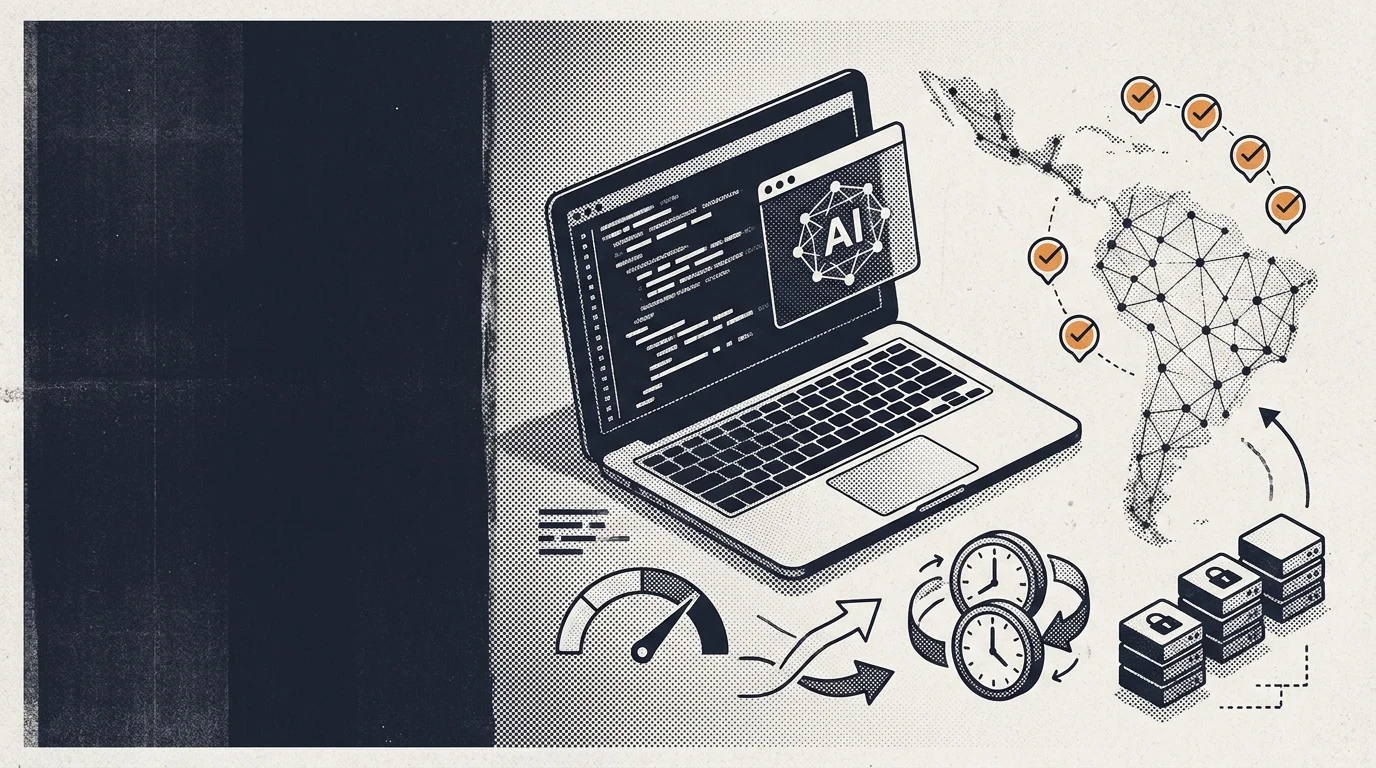
Latin American development teams that fully embrace AI tools combine the cost advantages of nearshoring with productivity and code quality that most in-house teams struggle to match. Here are five concrete advantages.
The conversation around AI in software development often misses something obvious: the teams who benefit most from AI tools are not necessarily the ones with the largest R&D budgets or the most senior engineers. They are the ones who have made AI a genuine part of their daily workflow — where Copilot, Claude, and Cursor are open alongside the editor, not occasionally consulted in a proof of concept.
At CT Developers, we’ve been building this culture deliberately since early 2023. What we’ve observed — and what the numbers from our client engagements confirm — is that a disciplined AI-ready nearshore team creates a compounding advantage that a traditional outsourcing model simply cannot replicate.
The AI multiplier in nearshore development
The value proposition of nearshoring has always been straightforward: access senior talent at a fraction of the US cost, in a compatible time zone. AI tools don’t change that math — they multiply it.
When a team member can stub out boilerplate in seconds, get a second opinion on a complex SQL query instantly, or use a language model to draft and refine test coverage without interrupting a flow state, the throughput per engineer goes up. The same budget now buys more delivered software. Not lower-quality software shipped faster — genuinely better software shipped faster.
The compounding effect matters. One sprint where AI tooling saves eight hours of rework is a curiosity. Twelve sprints where it consistently does so is a competitive advantage your in-house team will struggle to close.
“The productivity gap between an AI-native team and a team that uses AI occasionally is already larger than the gap between senior and mid-level engineers. It will only widen.”
— Marco Milon, CTO at CT Developers
Faster iteration cycles
The most immediate gain shows up in iteration speed. AI-assisted development compresses the cycle from idea to working code in several specific ways:
- Scaffolding and boilerplate generation. A senior engineer spending thirty minutes setting up a new API route or component structure is now spending five. That time goes back into design decisions and edge cases.
- Faster unblocking. When a developer hits an unfamiliar library or an obscure error, the time to resolution used to be proportional to their personal experience with that domain. With AI tools, a strong generalist can move through unfamiliar territory much faster.
- Reduced context-switching. Writing tests, documentation stubs, and commit messages are traditionally interruptions to deep work. With AI augmentation, they happen in-flow, so the developer stays in the problem longer.
The cumulative effect on a typical two-week sprint is measurable: teams we’ve tracked consistently deliver 25–35% more story points after fully adopting AI tooling, without a corresponding increase in bug rates.
Better code quality by default
It’s tempting to assume that faster output means more defects. The data from our projects suggests the opposite, for a few reasons.
First, AI tools make code review accessible at the line level, in real time. A developer can ask “what edge cases am I missing?” or “is there a more idiomatic way to handle this?” before a single line of code reaches the pull request. This moves quality left in the process, where it is cheapest.
Second, AI-assisted test writing lowers the activation energy for writing good coverage. Tests that developers would previously skip — because they’re tedious, not because they’re unimportant — get written. The coverage baseline rises.
Third, the shared context AI tools provide acts as a subtle style enforcer. When multiple engineers on a team use the same models and prompting patterns, the resulting code tends toward consistency in ways that code reviews alone cannot reliably enforce.
Cost efficiency that compounds
The nearshore cost advantage is already significant. A senior full-stack engineer in Argentina or Peru typically costs 40–60% less than a comparable US-based hire, after accounting for all-in employment costs. That gap doesn’t close when you add AI tooling; it widens productively.
Here’s why: in-house US teams often bear the overhead of more engineers than they strictly need, because senior time is expensive and junior engineers without AI tools are slow to become productive. An AI-native nearshore team inverts this: junior and mid-level engineers become productive faster, seniors spend less time on mentoring scaffolding, and the team ships at a rate that would previously require a larger headcount.
For a typical product team, this translates to shipping the same roadmap for 40–50% less, or shipping 40–50% more roadmap for the same budget. Neither outcome is available from a traditional nearshore arrangement where engineers are treating AI tools as optional.
Time zone alignment as a feature
One criticism of nearshoring that has merit is the asynchronous communication overhead. If your nearshore team is operating in Asia-Pacific time zones, the effective window for real-time collaboration might be two hours a day. That forces a lot of decision-making into async, which slows things down when rapid iteration is the goal.
Latin American teams operating in CDT/CST-adjacent time zones — Lima is UTC-5, Córdoba is UTC-3 — have 6–8 hours of overlap with most US business hours. That’s enough for:
- A daily standup where actual problems get solved, not just reported.
- Real-time pair programming when a problem genuinely benefits from it.
- Rapid feedback loops on PR reviews, design questions, and scope clarifications.
When you combine this overlap with AI tools that reduce the friction of async communication — auto-generating PR descriptions, drafting Slack updates, summarizing context for the next morning — the experience of working with the team approaches that of a co-located team, at a fraction of the cost.
What AI readiness actually looks like
“AI-ready” has become a marketing term, so it’s worth being specific about what it means in practice when evaluating a team.
A genuinely AI-ready development team:
- Uses AI tools daily, not as a novelty but as a reflex. Developers should be able to describe their specific prompt workflows for code review, debugging, and test generation.
- Has evaluated multiple tools for their specific use cases and made deliberate choices — not just defaulted to whatever is popular.
- Treats AI output as a first draft, not a final answer. The developers who get the most out of these tools are the ones who can quickly evaluate and edit the output, not the ones who accept it uncritically.
- Has processes for keeping AI tool usage consistent across the team — shared prompt libraries, agreed-upon review standards for AI-generated code, and a culture where asking “did you check this with Claude?” is routine.
When evaluating a prospective partner, ask to see a code review or a debugging session. You’ll learn more from watching how they work than from any case study.
The teams that build this muscle now are accumulating an advantage that will be very difficult to close later. The question isn’t whether AI tools will matter in software development — it’s whether the team you’re hiring has already decided they do.
MM Marco Milon
CTO & Co-founder, CT Developers
Marco is a software architect with 15+ years of experience building products across Latin America and the US. He leads the technical team at CT Developers and has been championing AI-augmented development since 2022.